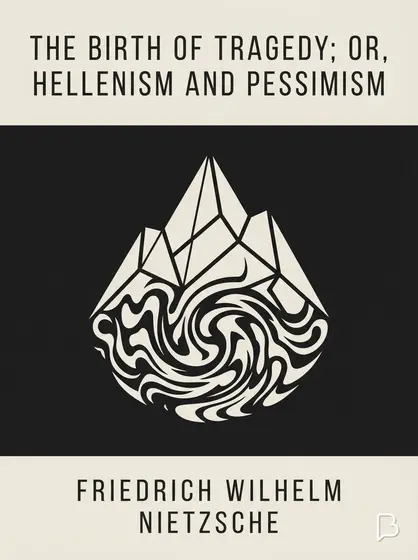
The Birth of Tragedy; or, Hellenism and Pessimism
Read this book freeEvery sentence translated, natural audio, one-tap dictionary
English books for C1 level (advanced) · Essays in English for learners, with translation
A philosophical treatise that examines the origins of Greek tragedy and its decline. The author argues that tragedy arose from the fusion of Apollonian and Dionysian forces, representing order and chaos. He critiques modern rationalism and praises the regenerative power of myth. The work is dense with ideas but written with passion. It challenges readers to think deeply, making it suitable for advanced learners.
Learn English with The Birth of Tragedy; or, Hellenism and Pessimism
- Suits learners around level C1: you read the original, not a simplified retelling.
- Who it suits: a long, demanding classic (C1), for confident readers, or for B1 to B2 readers with the translation on.
- 7,184 distinct words, each one a tap away from your personal vocabulary list.
- Translation into Russian, Spanish, Brazilian Portuguese, Japanese, Chinese, Turkish or Arabic, aligned to every sentence, shown under the text or beside it.
- Read-aloud audio for every chapter, with the current sentence highlighted as it is read.
- Read in English, glance at the translation under any sentence you are unsure of, and listen to natural read-aloud voices to train your ear.
How it works
- Open the book: no installation, it reads in the browser on any device.
- Read a sentence in English. Its translation sits right under it, so you never lose the thread.
- Tap a word for its meaning and save it; listen to the chapter read aloud.
More about the method →Read your own EPUB with translation →
Create a free accountRead full books, save your progress and vocabulary, upload your own books.
Questions about this book
Can I read The Birth of Tragedy; or, Hellenism and Pessimism in English for free?
Yes. The first chapters of The Birth of Tragedy; or, Hellenism and Pessimism open without an account, with the translation, audio and dictionary included. A free account unlocks the rest of the book.
How much English do I need?
The text is estimated at level C1. Because every sentence has its translation underneath, lower levels can follow along too.
Is there audio?
Yes. Each chapter can be read aloud by a natural-sounding voice while the current sentence is highlighted.
Is The Birth of Tragedy; or, Hellenism and Pessimism available in Russian?
Yes. On Booklern the English text of The Birth of Tragedy; or, Hellenism and Pessimism is shown with its Russian translation under every sentence, so you read the original and check the Russian whenever you need to.
Is The Birth of Tragedy; or, Hellenism and Pessimism available in Spanish?
Yes. On Booklern the English text of The Birth of Tragedy; or, Hellenism and Pessimism is shown with its Spanish translation under every sentence, so you read the original and check the Spanish whenever you need to.
Is The Birth of Tragedy; or, Hellenism and Pessimism available in Brazilian Portuguese?
Yes. On Booklern the English text of The Birth of Tragedy; or, Hellenism and Pessimism is shown with its Brazilian Portuguese translation under every sentence, so you read the original and check the Brazilian Portuguese whenever you need to.
Is The Birth of Tragedy; or, Hellenism and Pessimism available in Japanese?
Yes. On Booklern the English text of The Birth of Tragedy; or, Hellenism and Pessimism is shown with its Japanese translation under every sentence, so you read the original and check the Japanese whenever you need to.
Is The Birth of Tragedy; or, Hellenism and Pessimism available in Chinese?
Yes. On Booklern the English text of The Birth of Tragedy; or, Hellenism and Pessimism is shown with its Chinese translation under every sentence, so you read the original and check the Chinese whenever you need to.
Is The Birth of Tragedy; or, Hellenism and Pessimism available in Turkish?
Yes. On Booklern the English text of The Birth of Tragedy; or, Hellenism and Pessimism is shown with its Turkish translation under every sentence, so you read the original and check the Turkish whenever you need to.
Is The Birth of Tragedy; or, Hellenism and Pessimism available in Arabic?
Yes. On Booklern the English text of The Birth of Tragedy; or, Hellenism and Pessimism is shown with its Arabic translation under every sentence, so you read the original and check the Arabic whenever you need to.
Can I download The Birth of Tragedy; or, Hellenism and Pessimism as a PDF or EPUB?
Not from Booklern: the book is read online, in the browser, with nothing to download or install. Your place in the book is saved to your account.