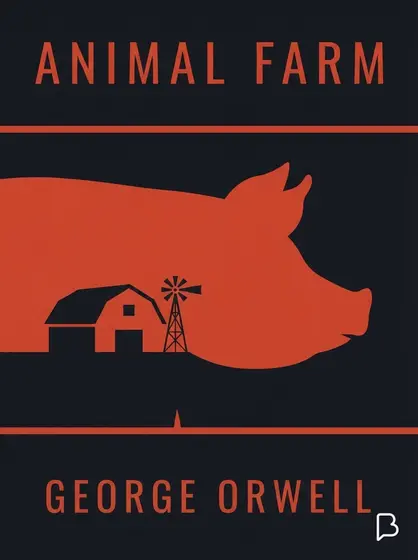
Rebelión en la granja: frases en inglés con traducción
Animal Farm
15 frases de «Rebelión en la granja» (George Orwell) en el inglés original, con la traducción al español debajo de cada una. Cada frase está tomada tal cual del libro, que puedes leer entero gratis con traducción, audio y diccionario.
Twelve voices were shouting in anger, and they were all alike. No question, now, what had happened to the faces of the pigs. The creatures outside looked from pig to man, and from man to pig, and from pig to man again; but already it was impossible to say which was which.
Doce voces gritaban con furia, y todas eran iguales. Ya no había duda de lo que había ocurrido con los rostros de los cerdos. Las criaturas de afuera miraban del cerdo al hombre, y del hombre al cerdo, y del cerdo al hombre otra vez; pero ya era imposible decir quién era quién.
"Four legs good, two legs BETTER! Four legs good, two legs BETTER! Four legs good, two legs BETTER!"
«Cuatro patas bueno, dos patas MEJOR! Cuatro patas bueno, dos patas MEJOR! Cuatro patas bueno, dos patas MEJOR!»
"Ah, that is different!" said Boxer. "If Comrade Napoleon says it, it must be right."
«Ah, eso es diferente!», dijo Boxer. «Si el camarada Napoleón lo dice, debe ser correcto.»
"No sentimentality, comrade!" cried Snowball from whose wounds the blood was still dripping. "War is war. The only good human being is a dead one."
«Nada de sentimentalismos, camarada!», gritó Snowball, de cuyas heridas aún goteaba la sangre. «La guerra es la guerra. El único ser humano bueno es el que está muerto.»
"'Alfred Simmonds, Horse Slaughterer and Glue Boiler, Willingdon. Dealer in Hides and Bone-Meal. Kennels Supplied.' Do you not understand what that means? They are taking Boxer to the knacker's!"
«Alfred Simmonds, Matarife de Caballos y Fundidor de Cola, Willingdon. Comerciante en Cueros y Harina de Huesos. Se Proveen Perreras.» No entiendes lo que eso significa? Se están llevando a Boxer al matadero!»
He had only one criticism, he said, to make of Mr. Pilkington's excellent and neighbourly speech. Mr. Pilkington had referred throughout to "Animal Farm." He could not of course know--for he, Napoleon, was only now for the first time announcing it--that the name "Animal Farm" had been abolished. Henceforward the farm was to be known as "The Manor Farm"--which, he believed, was its correct and original name.
Solo tenía una crítica, dijo, que hacer al excelente y vecino discurso del señor Pilkington. El señor Pilkington se había referido en todo momento a «Granja Animal». No podía, por supuesto, saber, pues él, Napoleón, solo ahora lo anunciaba por primera vez, que el nombre «Granja Animal» había sido abolido. En adelante la granja se conocería como «Granja Manor», que, creía él, era su nombre correcto y original.
"Bravery is not enough," said Squealer. "Loyalty and obedience are more important. And as to the Battle of the Cowshed, I believe the time will come when we shall find that Snowball's part in it was much exaggerated. Discipline, comrades, iron discipline! That is the watchword for today. One false step, and our enemies would be upon us. Surely, comrades, you do not want Jones back?"
«El valor no es suficiente», dijo Squealer. «La lealtad y la obediencia son más importantes. Y en cuanto a la Batalla del Establo, creo que llegará el momento en que descubramos que la participación de Snowball en ella fue muy exagerada. Disciplina, camaradas, disciplina de hierro! Esa es la consigna de hoy. Un paso en falso, y nuestros enemigos caerían sobre nosotros. Seguramente, camaradas, no quieren que Jones vuelva?»
"Comrade," said Snowball, "those ribbons that you are so devoted to are the badge of slavery. Can you not understand that liberty is worth more than ribbons?"
«Camarada», dijo Snowball, «esas cintas a las que tanto te dedicas son la insignia de la esclavitud. No puedes entender que la libertad vale más que las cintas?»
But a few days later Muriel, reading over the Seven Commandments to herself, noticed that there was yet another of them which the animals had remembered wrong. They had thought the Fifth Commandment was "No animal shall drink alcohol," but there were two words that they had forgotten. Actually the Commandment read: "No animal shall drink alcohol TO EXCESS."
Pero unos días después, Muriel, leyendo para sí misma los Siete Mandamientos, notó que había otro más que los animales habían recordado mal. Habían pensado que el Quinto Mandamiento era «Ningún animal beberá alcohol», pero había dos palabras que habían olvidado. En realidad el Mandamiento decía: «Ningún animal beberá alcohol EN EXCESO.»
"I do not understand it. I would not have believed that such things could happen on our farm. It must be due to some fault in ourselves. The solution, as I see it, is to work harder. From now onwards I shall get up a full hour earlier in the mornings."
«No lo entiendo. No habría creído que tales cosas pudieran suceder en nuestra granja. Debe ser por alguna falta en nosotros mismos. La solución, como yo lo veo, es trabajar más duro. De ahora en adelante me levantaré una hora más temprano por las mañanas.»
Years passed. The seasons came and went, the short animal lives fled by. A time came when there was no one who remembered the old days before the Rebellion, except Clover, Benjamin, Moses the raven, and a number of the pigs.
Pasaron los años. Las estaciones iban y venían, las cortas vidas animales huían. Llegó un tiempo en que no había nadie que recordara los viejos días antes de la Rebelión, excepto Clover, Benjamín, Moisés el cuervo, y varios de los cerdos.
They had just finished singing it for the third time when Squealer, attended by two dogs, approached them with the air of having something important to say. He announced that, by a special decree of Comrade Napoleon, 'Beasts of England' had been abolished. From now onwards it was forbidden to sing it.
Acababan de terminarla de cantar por tercera vez cuando Squealer, acompañado por dos perros, se les acercó con aire de tener algo importante que decir. Anunció que, por decreto especial del camarada Napoleón, «Bestias de Inglaterra» había sido abolida. De ahora en adelante estaba prohibido cantarla.
"Our Leader, Comrade Napoleon," announced Squealer, speaking very slowly and firmly, "has stated categorically--categorically, comrade--that Snowball was Jones's agent from the very beginning--yes, and from long before the Rebellion was ever thought of."
«Nuestro Líder, el camarada Napoleón», anunció Squealer, hablando muy despacio y con firmeza, «ha declarado categóricamente, categóricamente, camarada, que Snowball fue agente de Jones desde el principio, sí, y desde mucho antes de que se pensara en la Rebelión.»
"Then we have won back what we had before," said Boxer.
«Entonces hemos recuperado lo que teníamos antes», dijo Boxer.
"A bird's wing, comrades," he said, "is an organ of propulsion and not of manipulation. It should therefore be regarded as a leg. The distinguishing mark of man is the HAND, the instrument with which he does all his mischief."
«El ala de un pájaro, camaradas», dijo, «es un órgano de propulsión y no de manipulación. Por lo tanto debe considerarse como una pata. La marca distintiva del hombre es la MANO, el instrumento con el que hace todas sus fechorías.»
Leer el libro gratisCada oración traducida, audio natural, diccionario con un toque