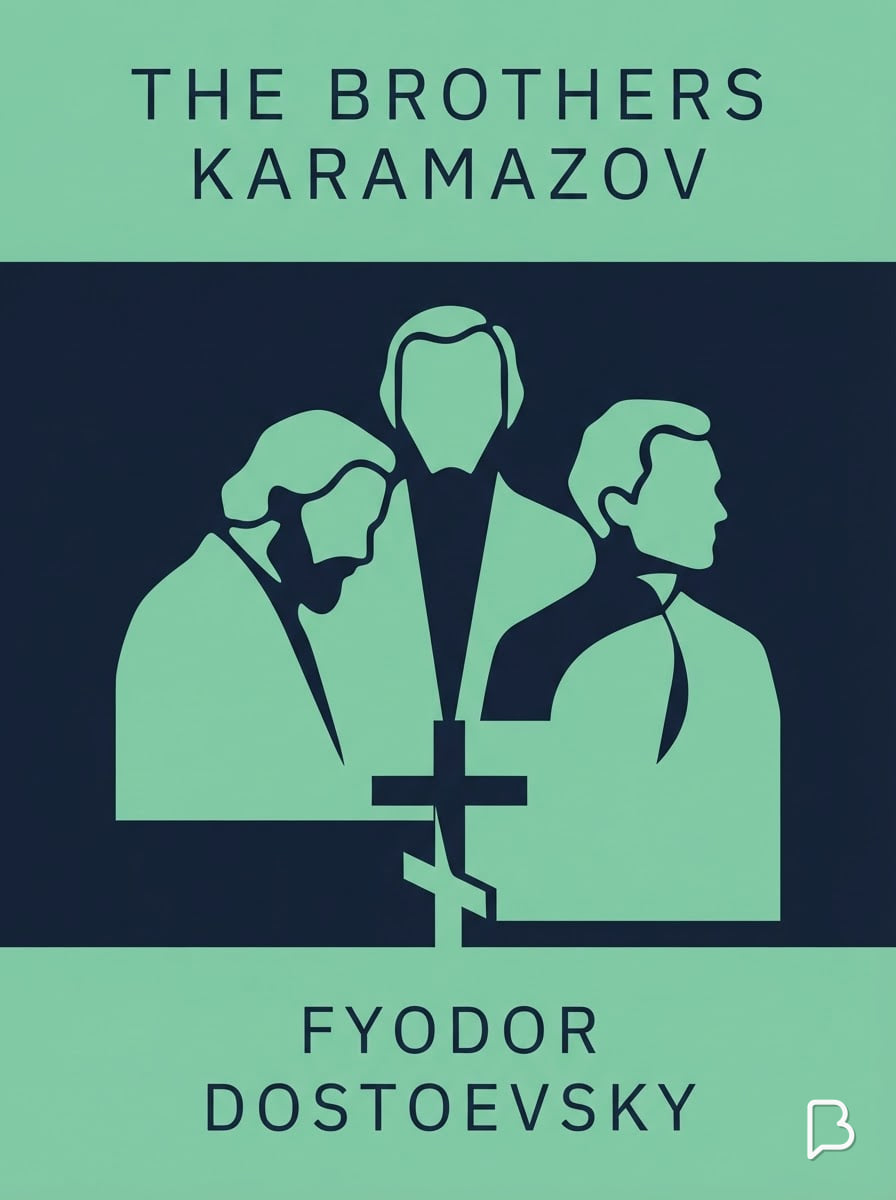
Los hermanos Karamázov: el comienzo del libro en inglés con traducción al español
The Brothers Karamazov
Las primeras páginas de Los hermanos Karamázov, de Fiódor Dostoyevski: el texto en inglés con la traducción al español bajo cada párrafo, unas 680 palabras, lo mismo que una o dos páginas del lector. Lee en inglés y mira la traducción cuando la necesites. El libro sigue gratis en el lector, con audio y diccionario.
Alexey Fyodorovitch Karamazov was the third son of Fyodor Pavlovitch Karamazov, a land owner well known in our district in his own day, and still remembered among us owing to his gloomy and tragic death, which happened thirteen years ago, and which I shall describe in its proper place. For the present I will only say that this “landowner” —for so we used to call him, although he hardly spent a day of his life on his own estate —was a strange type, yet one pretty frequently to be met with, a type abject and vicious and at the same time senseless. But he was one of those senseless persons who are very well capable of looking after their worldly affairs, and, apparently, after nothing else. Fyodor Pavlovitch, for instance, began with next to nothing; his estate was of the smallest; he ran to dine at other men’s tables, and fastened on them as a toady, yet at his death it appeared that he had a hundred thousand roubles in hard cash. At the same time, he was all his life one of the most senseless, fantastical fellows in the whole district. I repeat, it was not stupidity —the majority of these fantastical fellows are shrewd and intelligent enough —but just senselessness, and a peculiar national form of it.
Alexey Fyodorovitch Karamazov era el tercer hijo de Fyodor Pavlovitch Karamazov, un terrateniente muy conocido en nuestro distrito en su tiempo, y aún recordado entre nosotros debido a su muerte sombría y trágica, ocurrida hace trece años, y que describiré en su debido lugar. Por ahora solo diré que este "terrateniente", pues así solíamos llamarlo, aunque apenas pasaba un día de su vida en su propia finca, era un tipo extraño, pero bastante frecuente, un tipo abyecto y vicioso y al mismo tiempo insensato. Pero era una de esas personas insensatas que son muy capaces de cuidar sus asuntos mundanos, y, al parecer, de nada más. Fyodor Pavlovitch, por ejemplo, comenzó con casi nada; su finca era de las más pequeñas; se las arreglaba para cenar en mesas ajenas, y se adhería a ellas como un adulador, sin embargo, a su muerte resultó que tenía cien mil rublos en efectivo. Al mismo tiempo, fue toda su vida uno de los más insensatos y fantásticos sujetos de todo el distrito. Repito, no era estupidez, la mayoría de estos sujetos fantásticos son bastante astutos e inteligentes, sino simple insensatez, y una peculiar forma nacional de ella.
He was married twice, and had three sons, the eldest, Dmitri, by his first wife, and two, Ivan and Alexey, by his second. Fyodor Pavlovitch’s first wife, Adelaïda Ivanovna, belonged to a fairly rich and distinguished noble family, also landowners in our district, the Miüsovs. How it came to pass that an heiress, who was also a beauty, and moreover one of those vigorous, intelligent girls, so common in this generation, but sometimes also to be found in the last, could have married such a worthless, puny weakling, as we all called him, I won’t attempt to explain. I knew a young lady of the last “romantic” generation who after some years of an enigmatic passion for a gentleman, whom she might quite easily have married at any moment, invented insuperable obstacles to their union, and ended by throwing herself one stormy night into a rather deep and rapid river from a high bank, almost a precipice, and so perished, entirely to satisfy her own caprice, and to be like Shakespeare’s Ophelia. Indeed, if this precipice, a chosen and favorite spot of hers, had been less picturesque, if there had been a prosaic flat bank in its place, most likely the suicide would never have taken place. This is a fact, and probably there have been not a few similar instances in the last two or three generations. Adelaïda Ivanovna Miüsov’s action was similarly, no doubt, an echo of other people’s ideas, and was due to the irritation caused by lack of mental freedom. She wanted, perhaps, to show her feminine independence, to override class distinctions and the despotism of her family. And a pliable imagination persuaded her, we must suppose, for a brief moment, that Fyodor Pavlovitch, in spite of his parasitic position, was one of the bold and ironical spirits of that progressive epoch, though he was, in fact, an ill-natured buffoon and nothing more. What gave the marriage piquancy was that it was preceded by an elopement, and this greatly captivated Adelaïda Ivanovna’s fancy. Fyodor Pavlovitch’s position at the time made him specially eager for any such enterprise, for he was passionately anxious to make a career in one way or another. To attach himself to a good family and obtain a dowry was an alluring prospect. As for mutual love it did not exist apparently, either in the bride or in him, in spite of Adelaïda Ivanovna’s beauty. This was, perhaps, a unique case of the kind in the life of Fyodor Pavlovitch, who was always of a voluptuous temper, and ready to run after any petticoat on the slightest encouragement. She seems to have been the only woman who made no particular appeal to his senses.
Se casó dos veces, y tuvo tres hijos, el mayor, Dmitri, de su primera esposa, y dos, Ivan y Alexey, de la segunda. La primera esposa de Fyodor Pavlovitch, Adelaïda Ivanovna, pertenecía a una familia noble bastante rica y distinguida, también terratenientes en nuestro distrito, los Miüsov. Cómo sucedió que una heredera, que también era una belleza, y además una de esas chicas vigorosas e inteligentes, tan comunes en esta generación, pero a veces también presentes en la anterior, pudiera casarse con un debilucho inútil y mezquino, como todos lo llamábamos, no intentaré explicarlo. Conocí a una joven de la última generación "romántica" que, después de algunos años de pasión enigmática por un caballero con quien podría haberse casado fácilmente en cualquier momento, inventó obstáculos insuperables para su unión, y terminó arrojándose una noche de tormenta a un río bastante profundo y rápido desde una orilla alta, casi un precipicio, y así pereció, enteramente para satisfacer su propio capricho, y para ser como la Ofelia de Shakespeare. En efecto, si este precipicio, un lugar elegido y favorito para ella, hubiera sido menos pintoresco, si en su lugar hubiera habido una orilla plana y prosaica, lo más probable es que el suicidio nunca hubiera ocurrido. Esto es un hecho, y probablemente ha habido no pocos casos similares en las últimas dos o tres generaciones. La acción de Adelaïda Ivanovna Miüsov fue, sin duda, de manera similar, un eco de las ideas de otros, y se debió a la irritación causada por la falta de libertad mental. Ella quería, quizás, mostrar su independencia femenina, superar las distinciones de clase y el despotismo de su familia. Y una imaginación flexible la persuadió, debemos suponer, por un breve momento, de que Fyodor Pavlovitch, a pesar de su posición parasitaria, era uno de los espíritus audaces e irónicos de esa época progresista, aunque en realidad era un bufón malévolo y nada más. Lo que dio picante al matrimonio fue que fue precedido por una fuga, y esto cautivó enormemente la fantasía de Adelaïda Ivanovna. La posición de Fyodor Pavlovitch en ese momento lo hacía especialmente ansioso por cualquier empresa de ese tipo, pues deseaba apasionadamente hacer carrera de una u otra manera. Adherirse a una buena familia y obtener una dote era una perspectiva tentadora. En cuanto al amor mutuo, aparentemente no existía, ni en la novia ni en él, a pesar de la belleza de Adelaïda Ivanovna. Este fue, quizás, un caso único en la vida de Fyodor Pavlovitch, quien siempre fue de temperamento voluptuoso, y dispuesto a perseguir cualquier falda ante el menor estímulo. Ella parece haber sido la única mujer que no despertó particularmente sus sentidos.
Seguir leyendo gratisCada oración traducida, audio natural, diccionario con un toque